Rajamangala University of Technology Srivijaya (RUTS) manages the employment of its non-civil-service staff through a set of formal regulations covering recruitment, contracts, pay, benefits, discipline and appeals. The rules aim to ensure fairness, transparency and good governance, though they do not extend to workers supplied by outside contractors. Merit-based hiring Under its 2020 Regulations on Criteria and Procedures for Recruiting and Selecting University Employees, the university selects candidates on their knowledge, abilities, qualifications, experience and suitability for the post. The rules cover how vacancies are announced, how selection committees are formed, and how candidates are assessed through examinations and interviews.

RUTS SDG 8 Progress Report 2025: Decent Work and Economic Growth
Rajamangala University of Technology Srivijaya (RUTS) manages the employment of its non-civil-service staff through a set of formal regulations covering recruitment, contracts, pay, benefits, discipline and appeals. The rules aim to ensure fairness, transparency and good governance, though they do not extend to workers supplied by outside contractors. Merit-based hiring Under its 2020 Regulations on Criteria and Procedures for Recruiting and Selecting University Employees, the university selects candidates on their knowledge, abilities, qualifications, experience and suitability for the post. The rules cover how vacancies are announced, how selection committees are formed, and how candidates are assessed through examinations and interviews.
Rajamangala University of Technology Srivijaya (RUTS) has established a formal policy for adjusting employee compensation to promote fair remuneration and recognize staff performance. Under the university's announcement on employee compensation adjustments, effective from 1 October 2019, salary increases are determined based on performance appraisal results, position categories, and established university criteria. The policy allocates a budget for salary adjustments and considers factors such as employees’ performance, discipline, professional conduct, and suitability for university employment. It also provides guidelines for distributing salary increases across employee groups to ensure a systematic and transparent process. Through this policy, RUTS demonstrates its commitment to structured compensation management and employee recognition, supporting staff welfare and organizational development.
Rajamangala University of Technology Srivijaya (RMUTSV) governs the employment of its non-civil-service staff under its 2018 Regulation on Personnel Administration for University Employees. The regulation was approved by the University Council on 31 August 2018 and replaced the 2016 version. Under the regulation, employees are hired on fixed-term contracts. The first lasts four years, including a one-year probation, and the second lasts six years. A third contract can run until the end of the fiscal year in which the employee turns 60. Renewal depends on a satisfactory performance review, and performance is evaluated twice a year. Staff are entitled to leave, paid leave, overtime pay, travel expenses, and social security benefits. The university council must periodically review pay and benefits, taking cost-of-living changes and private-sector pay into account.
– Rajamangala University of Technology Srivijaya (RMUTSV) governs the employment of its non-civil-service staff under its 2018 Regulation on Personnel Administration for University Employees. The regulation was approved by the University Council on 31 August 2018 and replaced the 2016 version. Under the regulation, employees are hired on fixed-term contracts. The first lasts four years, including a one-year probation, and the second lasts six years. A third contract can run until the end of the fiscal year in which the employee turns 60. Renewal depends on a satisfactory performance review, and performance is evaluated twice a year. Staff are entitled to leave, paid leave, overtime pay, travel expenses, and social security benefits. The university council must periodically review pay and benefits, taking cost-of-living changes and private-sector pay into account.
Rajamangala University of Technology Srivijaya (RMUTSV) sets the employment rights of its university employees by borrowing heavily from civil service rules. The 2018 Regulation on Personnel Administration for University Employees says nothing about outsourced or agency-supplied workers. Rights modeled on civil servants. Employees paid from the university's budget receive benefits "by analogy" with those of civil servants in higher education institutions. These cover leave, pay during leave, overtime pay, travel expenses, meeting allowances and overseas travel. Working hours, public holidays and annual leave follow the Cabinet's rules for civil servants. Employees are also covered by social security law, and the university's personnel committee may grant additional benefits and welfare where it sees fit. Pay kept in line with the market.
Rajamangala University of Technology Srivijaya (RUTS) has announced a clear procedure for employees who wish to appeal decisions affecting their rights or compensation, as part of its commitment to fairness, transparency, and good governance in the workplace. Under the process, any university employee who believes a decision on pay, benefits, or other employment rights is incorrect or unfair may submit a written appeal to the Human Resources Division within 30 days of receiving notice of the decision. The appeal should state the issue, the reasons for disagreement, and any supporting documents. Once received, the appeal will be reviewed by a designated committee, which may invite the employee to provide additional information. The committee will then make a recommendation to the university’s executive management or the University Council for a final decision.
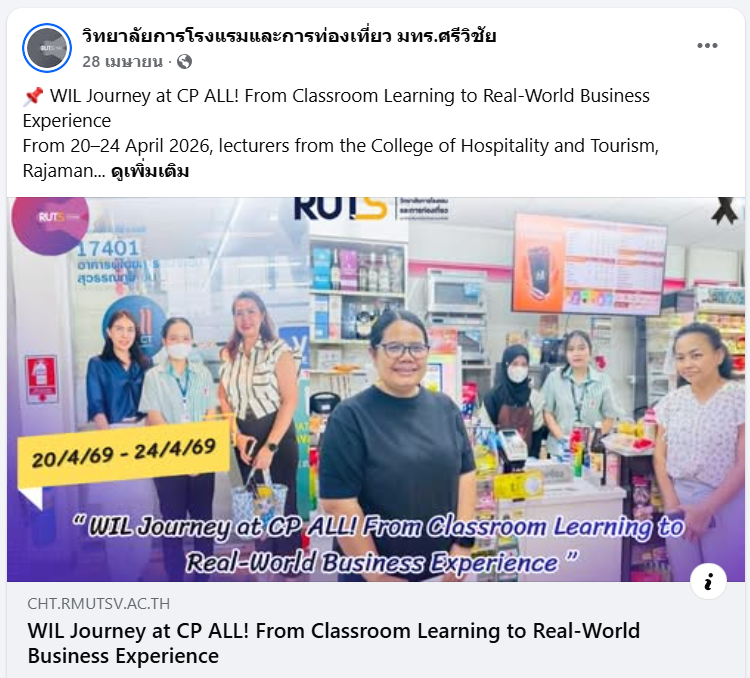
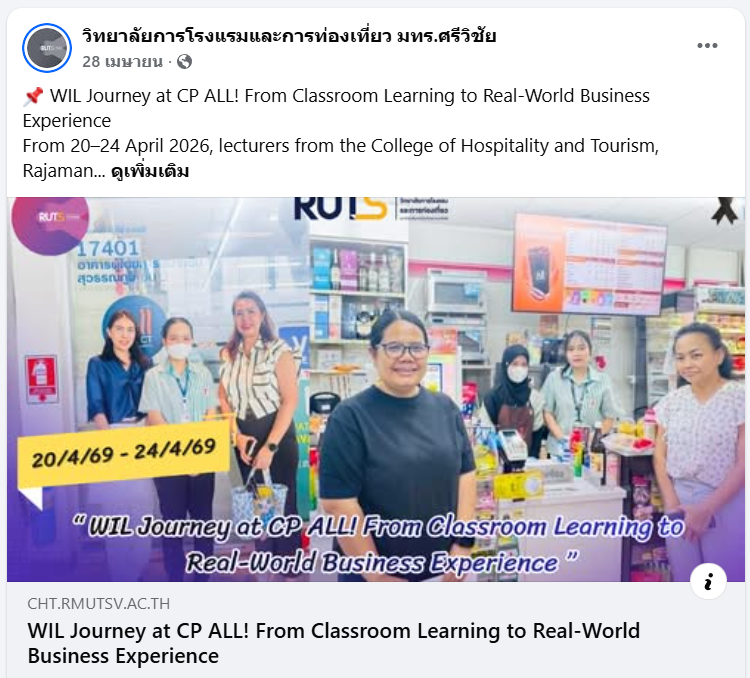
From 20 to 24 April 2026, lecturers from the College of Hospitality and Tourism, Rajamangala University of Technology Srivijaya, Trang Campus, led by Assistant Professor Nuchanat Tubkrut, Dr. Chayanun Khaoplod, Dr. Jatuporn Hokta, and Ms. Kittima Hemjinda, conducted supervisory visits for 67 Business Administration students from the Management and Business Development Program (Plan B) during their professional internship at CP ALL Public Company Limited. The internship placements cover establishments in Bang Na and Lat Krabang (Bangkok), as well as Bang Bo, Bang Phli, and Bang Sao Thong (Samut Prakan), running from 1 March to 31 May 2026. These supervisory visits form an integral part of the Work-integrated Learning (WIL) curriculum, specifically focusing on practical business management modules 2, 4, 6, and 8. The visits were filled with warmth, encouragement, and professional care.
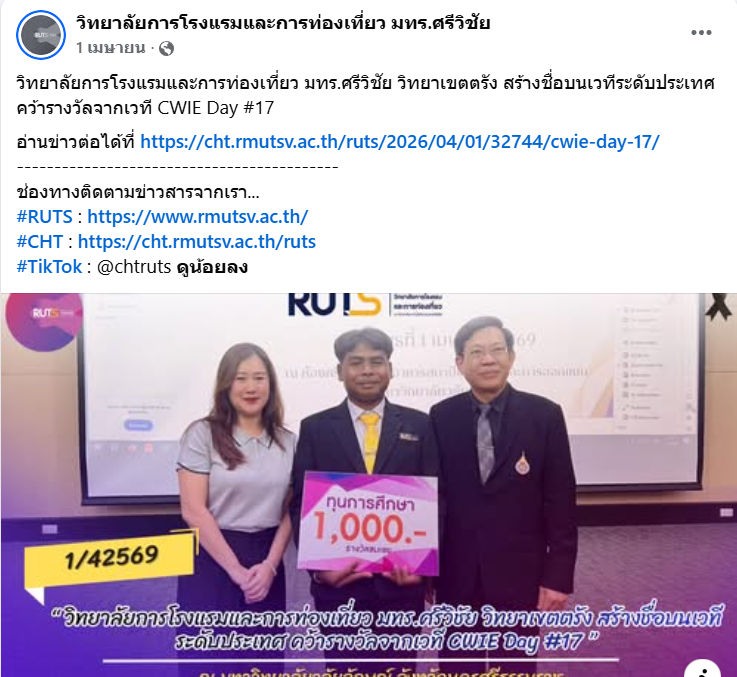
On April 1, 2026, the College of Hospitality and Tourism, Rajamangala University of Technology Srivijaya, Trang Campus, proudly announced that Mr. Jirawat Changnam, a second-year transfer student in the Tourism and Hospitality program, participated in the “17th Cooperative and Work-Integrated Education Day (CWIE Day #17)” held at Walailak University, Nakhon Si Thammarat Province. Mr. Jirawat Changnam was awarded fourth place (Honorable Mention) for his innovative project entitled “Recycled Tip Box from Aluminum Beverage Cans.” This project was collaboratively developed with the industry partner, Pimalai Resort and Spa, Krabi, under the close supervision of Ms. Wanwisa Ploy Insawang. The competition featured a total of 14 teams representing universities across Southern Thailand.
From 20 to 24 April 2025, lecturers from the College of Hospitality and Tourism, Rajamangala University of Technology Srivijaya, Trang Campus, led by Assistant Professor Nuchanat Tubkrut, Dr. Chayanun Khaoplod, Dr. Jatuporn Hokta, and Ms. Kittima Hemjinda, conducted supervisory visits for 67 Business Administration students from the Management and Business Development Program (Plan B) during their professional internship at CP ALL Public Company Limited. The internship placements cover establishments in Bang Na and Lat Krabang (Bangkok), as well as Bang Bo, Bang Phli, and Bang Sao Thong (Samut Prakan), running from 1 March to 31 May 2026. These supervisory visits form an integral part of the Work-integrated Learning (WIL) curriculum, specifically focusing on practical business management modules 2, 4, 6, and 8. The visits were filled with warmth, encouragement, and professional care.